Growing Marchantia plants
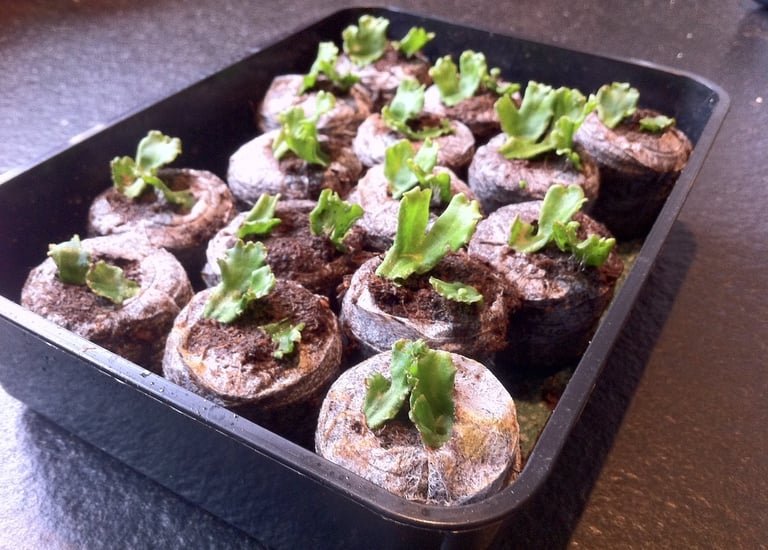
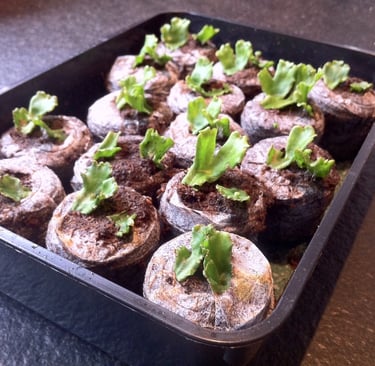
Marchantia polymorpha subsp. ruderalis is a common weed and easy to grow in compost media or substrates like vermiculite with nutrient media. Plants can be simply propagated from gemmae or cut thallus pieces, and grow quickly. A convenient alternative medium can be to grow plants on hydrated Jiffy-7 pots (right). However, nutrient and growth conditions eventually allow proliferation of algae, which will contaminate any harvested material. Alternatively, dry Jiffy-7 disks can be loaded into a vented box (e.g. SacO2 5 Litre Microbox with inbuilt filters), then autoclaved before hydration and planting with sterile material. Plants can be taken axenically through the life cycle to generate sterile spores in this way.
Hydroponic techniques offer the promise of fast and scaleable growth for plants, and I have been exploring ways of adapting these for Marchantia. Liverworts grow in prostrate fashion and lack root systems and specialised approaches are required.
Hydroponic systems
Any hydroponic system requires a nutrient source, support system for the plants and suitable source of lighting. I have explored the use of 3D printing to generate custom support trays that can be used to adapt off-the-shelf containers for hydroponic growth of Marchantia - at different scales. There are different types of hydroponic system: Deep Water Culture, where plant roots suspended directly in oxygenated, nutrient-rich water. Ebb and Flow (Flood & Drain) where a growing tray periodically floods with nutrient solution, then drains back. Drip Systems where nutrient solution drips onto the base of each plant. Wick Systems, where wicks passively draw nutrient solution up to roots by capillary action. These techniques are difficult to implement with plants like Marchantia, which are small, prostrate and without root systems - where nutrient uptake must pass through rhizoids growing from the base of plant thalli.
Two remaining techniques are more feasible: Aeroponics and Fogponics where roots (or rhizoids) hang in air and are misted with nutrient solution at intervals, and Nutrient Film Technique (NFT) where a thin film of nutrient solution flows continuously over roots/rhizoids in sloped channels. Attempts to implement spray or fog based delivery to rhizoids growing under support matting performed poorly - where high-speed sprays damaged unsupported rhizoids and ultrasonic-generated fog didn't deliver sufficient hydration, compared to direct access. So all of the successful trials used a form of nutrient film technique with plants growing on top of micro-perforated plastic (to minimise algal growth) and fed from beneath by nutrient flow through capillary matting. The hybrid matting is supported on 2cm pegs, which forms a lower surface for feeding rhizoids that growth through the top matting.
In the Technique section, I summarise the relative benefits and pitfalls that I have found with the different approaches to culture of Marchantia, with their atypical growth habit. From this has come a series of working prototypes for self-contained 'pod-like' devices for propagation of Marchantia plants at different scales. These 'hydropods' are designed to be relatively cheap to build and only need room temperature, a little electricity and a tabletop to run. These are well-tested and I am sharing construction details in the hope that they might be either directly useful or a starting point for further improvement. The pods have been under continual cycle of testing and improvement, and more a likely forthcoming. I'll be keeping notes on Bluesky (@jimhaseloff.bsky.social), and please drop me a note if any of this might be useful, but you need additional information or have questions.
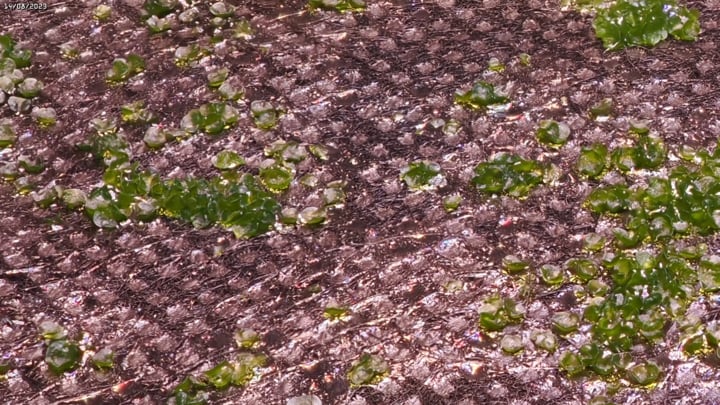
Early trials with membrane-based hydroponics showed that Marchantia can grow very quickly under the right conditions. An example of Marchantia gemmae germinating on sub-irrigated Weedban50 fabric is shown below. The timelapse video was taken over 2 weeks, by which time the plants had fully colonised the growth vessel. These trials prompted the development of self-contained systems that worked further to minimise algal overgrowth and improve yields and reliability.
Grow-pods
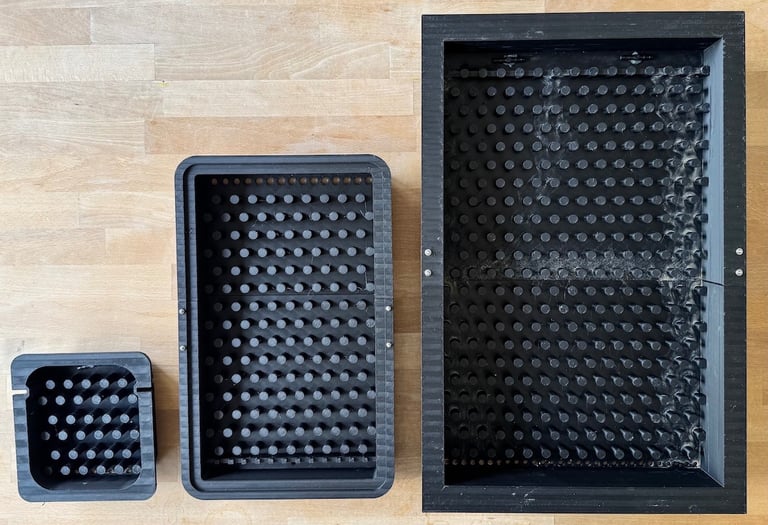
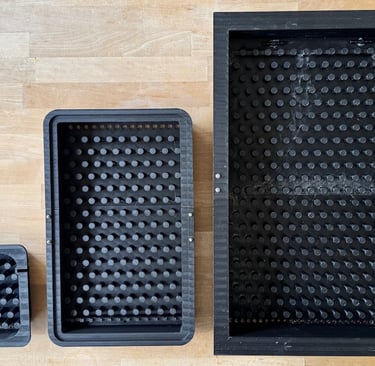
The testing of various propagation techniques for Marchantia has led to the design of self-contained pod-like systems that employ a type of nutrient film technique (NFT) hydroponics that has been adapted for Marchantia. The systems have a stacked arrangement of built-in reservoirs with nutrient circulation, specialised growing surfaces and spectrum-enhanced LED lighting systems. These have been built with three sizes of growing surface: Mini (12x12cm), Midi (19x30cm) and Super (28x42cm) for different applications and scales of plant propagation.
To make the grow-pods easy to build - commodity items were used where possible, with 3D printing used to adapt and customise the off-the-shelf components for reuse.
Mini, Midi and Super sized NFT hydroponics trays used in the different grow-pods
The grow-pods employ a novel scheme for split nutrient flow
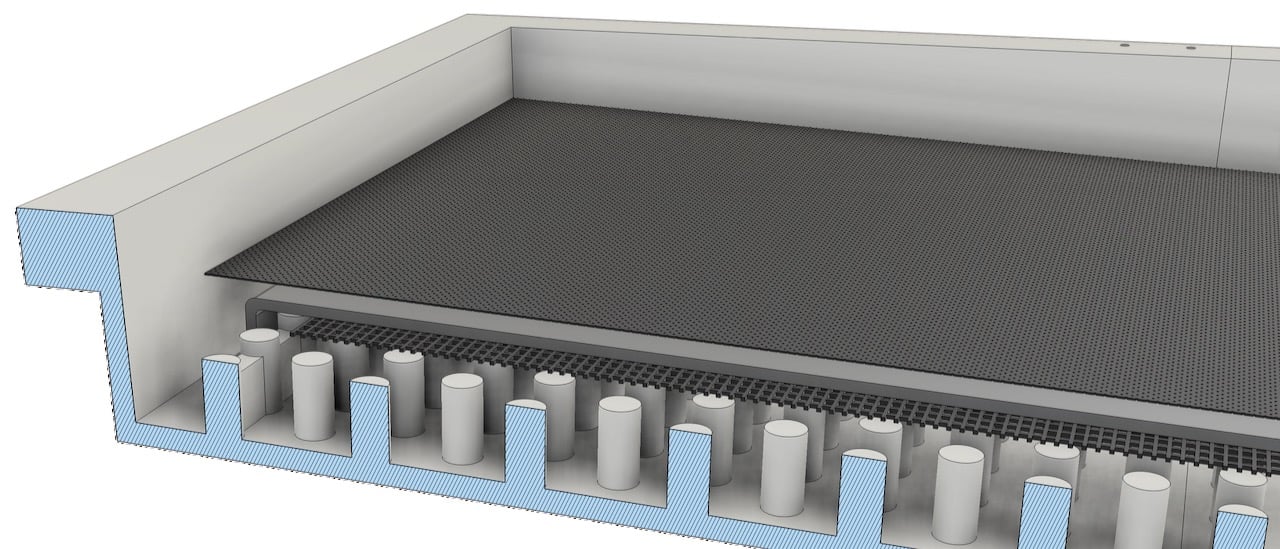
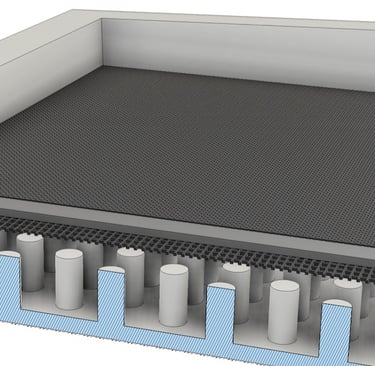
Nutrient media flow is split to (i) through the capillary matting layer, and (ii) along the base of the tray between the support pegs. The capillary mat supplies water and nutrient to any gemmae or thallus pieces planted on the growing surface and maintains this through the propagation period. The lower support pegs and nutrient film provide a fertile environment for subsequent growth of rhizoids and accelerated feeding. The multilayered arrangement also helps drain excess nutrient from the growing surface, which, with a micro perforated plastic film help to suppress competing algal growth.
Mini-NFT grow-pods
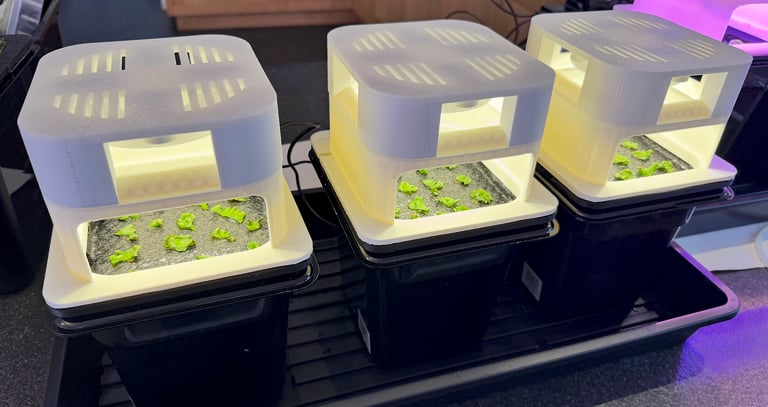
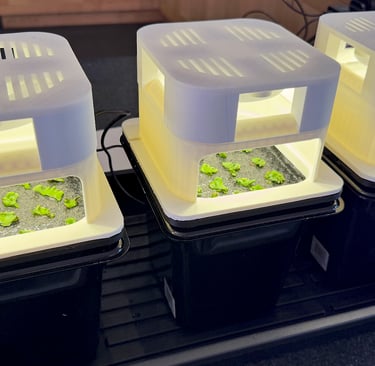
Gastronorm is a well-established size standard for food containers. The vessels are readily from cooking suppliers and available in fractional sizes and depths. I have used Gastronorm 1/6 black polycarbonate vessels, which are 176 × 162 mm ( 6.9 × 6.4 inches) and 200mm deep with a 1.5L working capacity - to build small hydroponic systems.
The relatively small size of the vessel means that hydroponic support trays can be printed on most commercial 3D printers. Each tray not only provides support for the plants, but act as conduits for wiring of a USB-powered mini-pump, hold up the LED ring lighting system and provide an engineered path for flow of nutrient solution through the system. Construction details can be found here.
Midi-NFT grow-pods
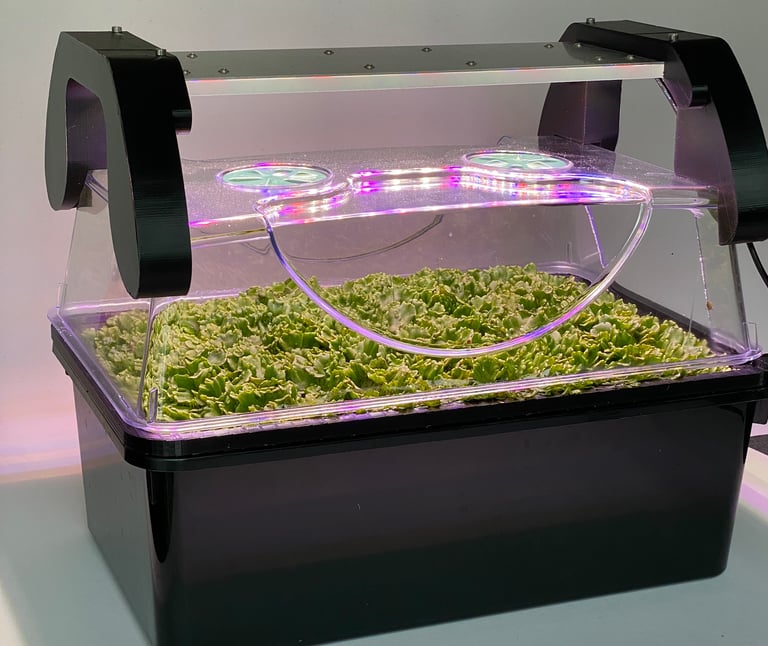
For a larger set of plants, I have used Garland Deep Root Seed Trays and propagator lid with single or dual multispectral LED panels for illumination. The key objective was to find low-cost vessels that were sufficiently deep with transparent vented lids. The flexibility of 3D printing makes it relatively easy to design and build trays for use with propagators from different manufacturers.
The hydroponics systems all share common features, with nutrient solution being pumped up from the reservoir and draining as a film across the inclined tray. An important design feature is that the plants are supported on layers of micro perforated black plastic, Henofa capillary matting and plastic mesh over a set of 2cm support pegs. There are two routes for nutrient flow (i) through the capillary matting for direct contact with the plants thalli, and (ii) along the surface of the tray that provides a thin film for access by plant rhizoids. This provides a continual source of nutrient for young plants or gemmae initially placed on the growing surface and a rich, aerated lower chamber for later stages of growth as rhizoids develop. Construction details can be found here.
Super-NFT grow-pods
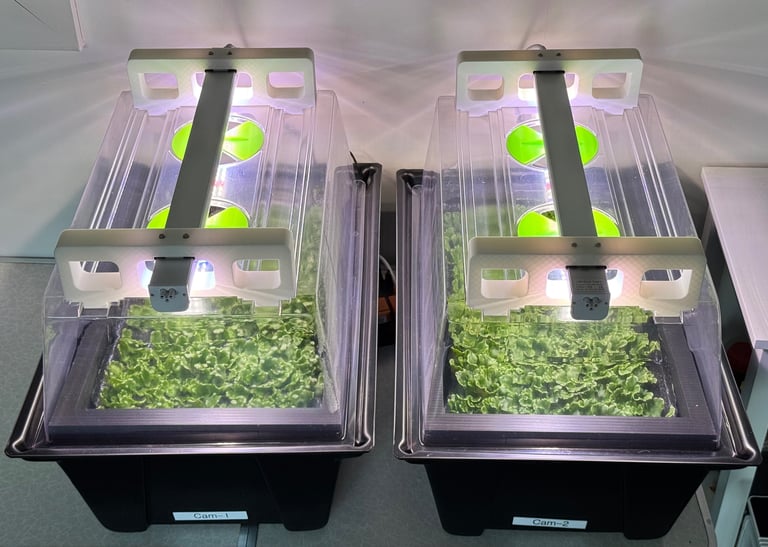
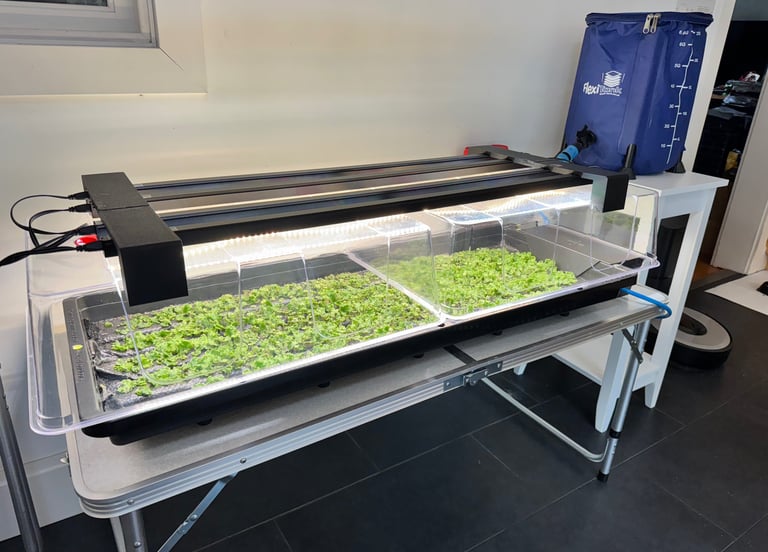
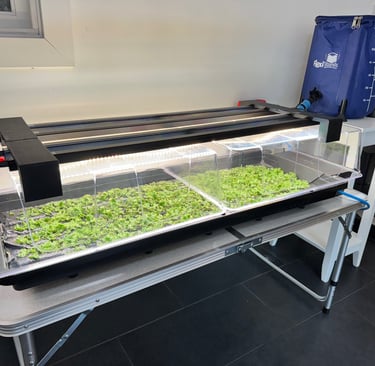
In less-than-successful attempts to trial aeroponic and fogponic techniques for Marchantia propagation, I started using X-Stream propagators. The robust tanks and propagator lids can be easily modified for nutrient film technique by printing customised trays and installing a suitable LED lighting system. The X-Stream 40 model provides extra space for plant growth and are vessels of choice for spore production, where male and female are grown through the reproductive cycle which can take 2-3 months. The vessels are also useful for rapid propagation of vegetative material.
The light sources are mains-powered LED strips for the X-Stream 40 based grow-pod (shown right) that are relatively cheap and easily obtained. In all of the systems described here, we usually run the lights with a 24h photoperiod, as this gives fast growth with no obvious penalty and dispenses with the need for electrical timing apparatus. Construction details can be found here.
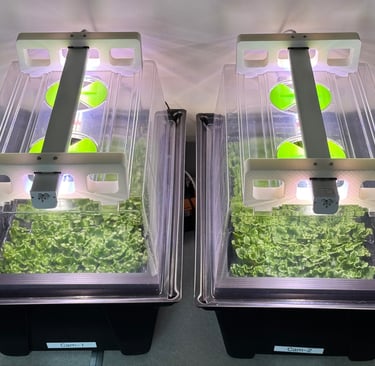
XXL-NFT Aquapot trays
For larger scale propagation we have adapted the Autopot Tray2Grow system. Autopot have developed a simple self-regulating valve that can automatically feed nutrient solution into large sub-irrigated trays. The standard setup can lead to water logging and poorer growth of Marchantia, however Li Hua Han in our lab showed that tilting the trays and creating a continual nutrient flow by addition of an open inlet and drain for recycling. Two Garland XL (58cm) propagator lids provide a vented cover, and off-the-shelf LED strips can provide lighting, mounted on custom 3D printed mounts. Repurposing of the large trays allows production of multiple kilograms of plant biomass although the Aquapot trays don't perform as efficiently as the custom versions.
(Still under development)
General growth conditions
Temperature: 15–22°C (59–72°F) and plants tolerates cool temperatures well. Avoid heat above 28°C. In temperate climates (or with air conditioning), plants can be grown inside.
Light: 150-250 µmol/sec/m2 wide spectrum light to support rapid growth. Generally run with long photoperiods, up to 24h. Vegetative growth requires a balance of blue and red light. Induction of the sexual phase of growth requires far red light (730-740nm).
Moisture & Humidity: Marchantia thallus requires consistent hydration but should not be waterlogged. Marchantia enjoys high humidity but permanently wet conditions need to be avoided.
Nutrients: We use off-the-shelf hydroponic solutions with a balanced rich combination of nitrogen, phosphorus and minor nutrients (Shogun Samurai Grow formulations). Click to download useful studies of the effects of nutrient composition on Marchantia growth that were published in a series of papers by Voth in 1940 and 1941 and 1943.
Marchantia as a platform for engineering plants
About Biomaker OpenPlant Cambridge Lab
Jim Haseloff
jimhaseloff@gmail.com

